Thursday, July 26, 2012

It was "King Lear" set on a farm in Iowa

The year was 1997, and Mama brought home A Thousand Acres for us to watch on a Saturday night. It could have been a Friday night, but that doesn't really matter. I don't remember much about the movie, I was only 14 or so at the time, and I can't say that a movie about two sisters fighting over a farm was that appealing.
What I do remember, however, did not prepare me for the book. It seems that they utilized that creative license to the fullest extent... by basically rewriting it all together. But it could just be my memory.

After all, how could I have forgotten that this beautiful fellow played Jess Clark?
Perhaps I blocked this from my memory, as I preferred to remember him as Mr. Darcy. No girl would daydream about one day meeting a Jess Clark, but he is a much better image than what I came up with on my own.

Forgive me. I digress.

A Thousand Acres won Jane Smiley the Pulitzer in 1992 and is, in fact, King Lear set on a farm in Iowa. Ever book review I have read started out that way, and this brief description was utilized as the summary for the movie. However, I would prefer to talk about the work in its own right.

There was something about Smiley's beautiful prose and Ginny's narrative that pulled me in and made me feel at home. Both sets of grandparents were farmers in one way or another, and there is a certain kind of hardness that comes with the profession. One cannot wallow in tragedy; one cannot simply take a day off because you are tired. The cows will still need milking, and the fields will still need tending. The land doesn't take a holiday, and it can be just as callous as hard working hands.

The storyline is simple. The father, Larry Cook, has decided that the time has come to turn his thousand-acre farm into a corporation that would then go to his three daughters. Ginny, the oldest, simply does as she is told. That's what she has pretty much always done. Rose, the middle daughter, has no problem taking the farm as she feels it is her right, and Caroline, the youngest and a lawyer in the big city, has no interest in the land. Family secrets and forgotten memories are brought to light as the father slowly slips into senility, and the sisters and spouses are at constant odds.

While there is much more going on in this quiet novel, what stuck with me was the father's preoccupation with growing and subduing the land for family and prestige, and in the end, not only is the farm lost, divided up and sold to the highest bidder, but the family is destroyed. Smiley creates a realistic world in where there are no perfect specimens of the human race. Each sister, husband, father, neighbor has their own faults, their own baggage, and their own motives that drive them to the devastating end.

For dirt and water.

For stubbornness and envy.

For the Cooks, blood didn't run that thick after all.

While A Thousand Acres is, in fact, King Lear set on a farm, it is so much more than that. Smiley took a classic story and modernized and twisted it to the American culture, our passions and desires, for better or for worse.

Over the next few months, I will have to deviate from my Pulitzer quest. I will instead read other American greats such as Emerson, Melville, and Alcott among others. In stolen moments of spare time, I plan to read Andersonville by MacKinlay Kantor (1956). However, it may be Christmas before that is accomplished.

Until then, dear readers.... Happy reading.


Wednesday, July 25, 2012

We meet again, Mr. Faulkner

So I must admit that, even as an English major, I have only read two Faulkner novels: Intruder in the Dust and The Sound and the Fury.  While I can respect him as an excellent spinner of tales, his long-winded sentences left me breathless and (more often than not) confused. Until I realized that Mr. Faulkner is much better understood and appreciated when read aloud. The Reivers was a perfect example.


Winner of the 1963 Pulitzer, The Reivers is a coming-of-age story about a young boy names Lucius Priest from Jefferson, Mississippi. Told as a memory to a grandchild, the book begins: Grandfather said:


What follows is a wonderfully sorted tale of misadventures, and it all begins with a death and a trip to New Orleans (or Mobile or somewhere). And as the old saying goes, when the cat's away....

Boon Hogganbeck, the hired hand, and Lucius take a road trip in Boss's new automobile up to Memphis, only to discover later that Ned, the coachman, had tagged along in the back. Of course, we wouldn't have much of a story, if these three guys didn't get into some sort of trouble. Boon exposes the young Lucius to a great deal in the four days they are in Memphis: racehorses, gambling, drinking, bawdy houses, and a pretentious deputy aiming for a fight. What fun!

What I found most interesting is Lucius revelation upon his return to Jefferson: It hasn't even changed! Because it should have. It should have been altered, even if only a little. I don't mean it should have changed of itself, but that I, bringing back to it what the last four days must have changed in me, should have altered it. What truth!

When I read this, I was immediately reminded of the short story by Stephen King, The Body, in which a group of young boys go off to find the dead body of Ray Brower. When they return, it is impossible to go back to the way things were, yet everything is still the same. Thomas Wolfe always confused me with his quote: You can't go home again. Perhaps, this is what he means.

While some of the language was dated for me, I thoroughly enjoyed this book. I think, so far, it is my favorite work of his. Some may disagree in that they prefer his other Yoknapatawpha County works, but I have nothing at this point to which to compare.

We will meet again, Mr. Faulkner and I. I will pull up a chair, pour a hot cup of coffee, and say, "Hello there old friend. Tell me a story." Then I will sit back and allow his southern drawl to lull me back to Mississippi, to dirt roads and red clay. Until then, Mr. Faulkner, take care.

Up next, A Thousand Acres by Jane Smiley (1992).

Until then... Happy reading.

Monday, July 23, 2012

If you sell the land, it is the end...

The Good Earth is about just that, the good earth, the land that brings forth prosperity or devastation. Pearl S. Buck won the Pulitzer for this work in 1932. Interesting enough, the entire work takes place in China before the revolution and the last emperor still reigned.
We meet Wang Lung on his wedding day. His father had arranged the union with the lady of the House of Hwang. He will marry a servant not to pretty as Wang Lung is not in need of a pretty woman and the trouble she brings. Her name is O-lan, and upon their union, she spends the rest of her days selflessly providing for her less than endearing husband. A hard worker, Wang Lung falls into fortune as the gods bless his fields. Instead of saving the money for hard times, he invests it in the land, slowly buying pieces of soil from the House of Hwang until he owns it all. Even the house itself.

At first meeting, Wang Lung is likable enough, a poor farmer plowing the fields. However, as he grows in his wealth and reputation, he moves into the House of Hwang and way from the fields, becoming lazy and idle and throwing money at problems to make them disappear. Wang Lung returns to the land time and time again to sooth his suffering. It is the land that provides, and while he understood that, it was a lesson he failed to pass on to his sons.  In the end (spoiler alert!!), the sons' knowing smiles imply that they will not heed their father's advise, and as soon as he dies, the land will be sold. The end, in this case, it two fold.

Buck aptly describes what happens when wealth is simply given and not earned. While Wang Lung worked the land to bring forth fruit, his sons merely enjoyed the benefits. Wang Lung wanted better for his sons; they should have better than he, toiling in the fields was for no son of his. My how the circle keeps on turning, and there is nothing new under the sun! It is from the earth that life is sustained, fed and nurtured. Wang Lung's trouble came when he deviated from that. A lesson more easily observed from the outside than from within.

While daunting in size, The Good Earth is a fairly easy read with simple writing and a somewhat engaging plot. There were even a few things I could take away from the novel... maybe, dare I say it, what not to do as a parent.

Up next, The Reivers by William Faulkner, winner of the Pulitzer in 1963. Until then... Happy reading.

Empire Falls

Empire Falls won the Pulitzer Prize in 2002, and while it was a quiet novel, I enjoyed my journey with Miles,  Tick, and the rest of the eclectic cast of characters living in a dying town. Perhaps I enjoyed it because I came from a small town much like Empire Falls, a small community of people living out their existence without ever venturing beyond the city limits. Everyone has history with everyone, and past mistakes are hard to escape. At the heart, I think I enjoyed it most for the characters. In this novel, Richard Russo was able to capture the true essence of each individual, plopping you down in the middle of their world and slowly revealing glimpses of the past as the protagonist, Miles Roby makes sense of what his life has become.

Miles struggles with his divorce, caring for his daughter, and keeping the grill afloat, all under the watchful eye of Francine Whiting. Much like the Eye of Mordor, she sees and knows everything, making it hard for Miles to escape her clutches. However, it is not just Whiting that ties him to Empire Falls; Miles, himself, is innately unable to make a decision, to take control, allowing Whiting to pull the strings and driving his wife to the arms of another man.

While the book description promises hilarity, it is few and far between in these soul-searching pages. However, there is some comic relief in the form of one Silver Fox, the fiancee of Miles' ex-wife and a realtor in Empire Falls. The Silver Fox has commandeered Miles' old life, sleeping with is wife, living in his house, and invading the Empire Grill to salt the proverbial wound. While he is a character one immediately loves to hate, he is necessary to allow the reader to breath under the wait of something quiet but powerful.

I have been told by other avid readers that this is not the greatest of Russo's work, and that may very well be true. I have found on this Pulitzer journey that the committee sometimes misses the mark (in my humble opinion, of course), but I think Empire Falls offers up the life of a small blue-collar town trying to make it. From where I sit now in 2012, isn't that the new American dream? Just to make it?

Perhaps. I don't know. What I do know is that I find joy my daughter's innocence, in a hot cup of coffee and a good book, in a house full of people I love.

Up next The Good Earth by Pearl S. Buck, winner of the 1932 Pulitzer Prize.

Until then, my friends.... Happy reading.


Tuesday, May 15, 2012

A Brief Detour and a New Journey

So... Upon finishing Lonesome Dove, I took a brief detour to read a few things now quite literary enough to be considered for the Pulitzer Prize. And by a few, I mean four. My sister had given me Extremely Loud and Incredibly Close for Christmas, and I just couldn't wait a few more YEARS to read it. I put the quest on hold, figuring even the greatest of warriors rested from battle. I was not disappointed. I have come to trust her taste in books, and she could not sing this book's praises any louder were she using a megaphone from a mountain top, and I must agree with her. Set post-911, the book revolves around the mind of an 11-year-old boy whose father died when the twin towers fell. What could wallow in the deepest pits of despair manages to be a message of hope, a way of consciously choosing to make something other than it is in order to bear its weight. As I write this, I am reminded of another excellent work, The Life of Pi, where, in much the same light, a young boy reinvents his reality in order for him to swallow it. We follow him on his quest to uncover a secret message left by his ghost father but watch as he untangles the knots of his past. In the end, I must admit, I was slightly disappointed... but only slightly, for there is always hope. There is always light.

In almost the same night I finished the great work, I picked up The Hunger Games by Suzanne Collins. I had this book on my to-read list for the past two years when a colleague of mine spoke about it at our monthly book club. The movie was coming out in a few months, and, as I am a stickler for reading the book before the movie, I decided now was the time. And thus started my five-day addiction... Within two nights of reading, the first book was finished, and fortunately for me, I had the foresight to check the entire trilogy all at once.


I immediately started the second book, Catching Fire, but had to convince myself to be an adult to go to bed. It was well after 2 in the morning. Within two more days, I was starting on the final book,Mockingjay, and within another day and half, I was finished. And then the withdrawals set in... You know, that sense of loss when you finish a great series, the whole in your heart left when you leave their world only to be left with repeats.

The three novels center around Katniss Everdeen who finds herself in the fight to the death in a distopia formally know as North America. You, like thousands (millions) of others, have probably already read the series, so I will not bore you with the plot line and summary. I will say that it was nice to see a strong female character that defiantly fought against the "Capitol" and didn't just pine away for a boy. But for a brief week, I came the closest I think I will ever come to knowing what an addiction felt like.

Seconds seemed like days and minutes seemed like years as I (im)patiently waited for my daughter to go to bed so that I find Katniss waiting for me in the area. Just where I left her, always near certain death. I would then read, hardly noticing the passing of time, ignoring my saint of a husband until he long gone to sleep. Fortunately, my addiction was short lived. But with that said, it took me awhile to want to move on. To "meet" someone new, another friend in another world. So I waited. It's best not to rush these things but to let them slowly fade away, making room for another hero, another friend. While I was waiting, I received some most overwhelming news. I had been accepted into Auburn University's Master of English program. Not only was I accepted but I was offered a GTA position with full tuition and a stipend, a deal too great for this bookish school girl to turn down. So with a deep breath and a heavy heart, I quit job and start school in the fall. At 30 years old, I am either setting a great example for my daughter to be a life-long learner or I am completely crazy. I go back and forth.

 So here's to new adventures, real and imagined, and now back to the quest. For a warrior must continue lest he grow faint of heart. Up next: Empire Falls by Richard Russo, winner of the 2002 Pulitzer Prize.

 Until then, my friends... Happy Reading.

Tuesday, February 7, 2012

Two Books with One Blog...

All winning streaks must come to an end at some point, right? Well, Humboldt's Gift was a large disappointment. I can understand why the committee liked it, but for me it was a less than entertaining read. I found it too heady and philosophical (and even that was hard to follow at times). Perhaps I am just not in the right phase of life to appreciate it, but I don't plan on rereading it to find out.

The story follows a once-successful Pulizer-Prize winning author who has fallen on hard times. He learns that his dear friend and mentor, Humbolt, has died, which sends him into self-deprecating meditations. His sordid past and poor investments are revealed in a painfully slow manner. He ends up in some criminally funny situations, but the plot is lost in the periodic monologues of heady thoughts.

With that said....

I was relieved to pick up Lonesome Dove.

Lonesome Dove, written by Larry McMurtry and winner of 1985 Pulitzer, was a wonderful adventure of the last frontier. The two main characters are Augustus  McCrae and Woodrow Call, two ex-Texas Rangers that own a livery outside of Lonesome Dove. They are complete opposites in every way to people can be, but they are connected as one person.  Life is great for the Hat Creek gang, albeit dull, until (as in all great westerns) a stranger rides into town. Well, to be honest, he wasn't a stranger but a distant memory from their rangering days, but the effect was still the same.  
His name was Jake Spoon, and he had gotten himself into a bit of trouble up in Arizona. He mentions the last remaining wilderness of Montana, a cattle-driver's paradise, and that was all it took to spur the suppressed desire for adventure in William Call. The rest of the story recounts their adventures on an unprecedented cattle drive to Montana. To make it more interesting, Jake Spoon unwillingly carts along Miss Lorena Wood, the only whore in Lonesome Dove.  

In Lonesome Dove, McMurtry has penned some amazing characters. He flawlessly shifts your opinion of Jake Spoon as he floats from day to day with no direction, his moral code slipping along the way. You innately like Augustus McCrae, even if he is a bit of a scoundrel, and you desperately hope for Call to change, to become the man he can't admit himself to be. In the end, it's a haunting tale; everyone is looking for something, something to end the loneliness, but all settle for something a little less than ideal in the end. McMurtry's characters demonstrate how everyone is interconnected and how the crazy idea of a lackluster drifter can alter the lives of so many.

Well done.

I think I will take a break from the Pulitzers for a moment. The Hunger Games has been on my list for a while, and with the upcoming movie, I have decided to bump it up on the list.

Until then... Happy Reading.


Tuesday, January 17, 2012

The Travels of Jaimie McPheeters

So it seems I'm on a roll reading books that I honestly enjoy. While somewhat dated and at times flowery for my taste, I found this "Tom Sawyer" like tale engaging and well worth the read.

Winner of the 1959 Pulitzer, The Travels of Jaimie McPheeters by Robert Lewis Taylor follows the wiley antics and coming-of-age of.... wait for it.... you guessed it: Jaimie McPheeters.

The year is 1849, and gold has been discovered in the west. Dr. McPheeters, Jaimie's father, is deep in debt, and eager to start affresh on the trail for fortune. Jaimie, eager to escape another year of school, eager goes with him, leaving his mother alone in Kentucky to fight off the creditors. The remaining chapters depict their adventures, fortunes and misfortunes alike.

From the begining, I had a great feeling about this book. Maybe it was residue from finishing yet another great read. Perhaps it was because my father enjoyed it so much. Or maybe it is just that Robert Lewis Taylor is just that good. Whatever the reason, I breezed through the first chapters with little henderance. However...

After Jaimie's second encounter with less-than-friendly natives, my enthusiasm began to wane. Wondering if Taylor simply took Huck Finn from the Mississippi River and placed him the gold rush, I barreled through, waiting for the entire book to be comprised of kidnappings and sterotypes. To my great delight, Taylor proved my worries invalid, mixing things up a bit with fool's gold, showdowns, and thievery.

And as with all great books, the ending came much too quickly. I feel much like Jaimie as he watches his father leave for the last time: "Probably I should have felt sad, because I had an uneasy feeling that we would never see him again. But I couldn't help smiling instead. It was alright. The pot of gold, the real strike, his dream run to earth, lay somewhere up ahead, around the next bend of the trail. It was alright. That next bend was my father's pot of gold, just as I'd said in my letter. I wondered how long he could have lasted before those beckoning hills stirred the old restlessness. How many months before the ranch itself was an enemy, and, the first crack had appeared that told of trouble coming? We waved goodbye, and I watched him ride away to keep his appointment with Fortune."

So we part ways here. I continue on my quest a little better for having know Jaimie McPheeters, and I'm optimistic as I select my next Pulitzer, Humbolt's Gift by Saul Bellows.

Until then, my friends... Happy reading!

Wednesday, September 21, 2011

"He had forgotten the Cause."

"... When the guns began firing he had forgotten it completely. It seemed very strange now to think of morality, or that minister long ago, or the poor runaway black. He looked out across the dark field, could see nothing but the yellow lights and outlines of black bodies stark in the lightning."

In The Killer Angels (1975), Michael Shaara captures the human side of the Civil War, specifically the Battle of Gettysburg, by focusing on the key players involved. Much like the movie Titanic, there is no risk of spoiling the ending; everyone knows the South loses this famous battle and most of its men in the processes. However, Shaara breaths new life into an old story by taking it back to the people, by introducing the human element that history books lack, caught up in the whos and the whats but not the motivations, the relationships and the passions.

Not much one for historical fiction, not to mention gory war novels, I was riveted, rushing headlong into the bloody battle, knowing perfectly well how it would end but wanting the soldiers to live. I had become invested. They had become people.

They were real men fighting for a dream, for a cause, for a lie. Each of them with a different motive; each of them with something to prove: courage, loyalty, that they are better men than most. These men were not ordered to fight by a king but willingly volunteered for the Cause, for the idea. My heart ached for the friends, Armistead and Hancock, finding themselves separated by the war and as enemies at the top of Cemetery Hill. "If I lift a hand against you, friend, may God strike me dead." Breaking a vow of friendship for the sake of loyalty to an idea, a Cause. The reason for the war as varied as the perspective of players.

Does it matter in the end? Lee asks the question "If the ware goes on- and it will, it will - what else can we do be go on? It is the same question forever, what else can we do? If they fight, we will fight with them. And does it matter after all who wins? Was that ever really the question? Will God ask that question in the end?"

God must grow tired of being called down on both sides of a war.

Up next... The Travels of Jaimie McPheeters by Robert Lewis Taylor, winner of the 1959 Pulitzer.

Until then my friends... Happy reading.

"But there are still the hours, aren't there?"

"...One and then another, and you get through that one and then, my god, there's another." Winner of the Pulitzer Prize in 1999, The Hours is a glimpse into the lives of three women: Virgina Wolfe, Laura Brown, and Clarissa Vaughan. All three exist in different places in time, but their lives intertwine in an unsuspecting twist. So understanded, that I almost missed it, and I believe I did miss it when I watched the movie. Perhaps I can pass that off to time and ignorance. I was over ten years younger and spend most of the movie marveling at Nicole Kidmans prosthetic nose.

I digress...

The book revolves around Wolfe's novel Mrs. Dalloway: Virginia is in the process of writing the novel, Laura (a 1950's suburban housewife) is reading the novel, and Clarissa, an independant New Yorker, finds herself in a parrallel universe, unknowingly portraying Mrs. Dalloway as she goes about planning a party in honor a beloved poet. All three women go about their lives, getting through the hours and struggling with their own demons: Virginia with the voices in her head, Laura with the mundane existence as a housewife and her embarrassing failure in baking a birthday cake for her husband, Clarissa with the actuallity of her life and the memories of a past she cannot get back.

At this point in my life, I found this book especially poignant for at times, I find myself frustrated with the mundane events that can take up the hours of a day: loading the dishwasher for the eighth time, washing an almost identical load of laundry as the previous week, picking up my daughter's dirty socks that mysteriously migrate from room to room without the aid of tiny feet. Not to mention the eight hours spend improving the lifes of others, or at leaset attempting to. It is easy to get bogged down in the hours of the day, the hours that you almost have to 'survive,' that you forget to enjoy, to revel in the thrill of living. As Cunningham so aptly states, "We live out lives, do whatever we do, and then we sleep - it's as simple and ordinary as that. ... There's just this for consolation: an hour here or there when our lives seem, against all odds and expectations, to burst open and give us everything we've ever imagined, though everyone but children (and perhaps even they) knows these hours will inevitably be followed by others, far darker and more difficult. Still we cherish the city, the morning; we hope, more than anything, for more."

So here I sit at the computer, the soft glow of the screen drying my tired eyes. The sink is empty, and the dirty clothes safely stored until laundry day rolls back around. My daughter dreams blissful dreams of coloring books, crayons, and cows. The hour is growing late, and it is time to call it a night. And while there are times I desire to run away, to shrug off the cloak of responsibility, I will go to bed wanting another year, another day, another hour of this life.

Up next... The Killer Angers by Michael Shaara, winner of the 1975 Pulitzer.

Until then, my friends... Happy reading.

Wednesday, September 14, 2011

A Good Scent from a Strange Mountain

A Good Scent from a Strange Mountain by Robert Olen Butler won the Pulitzer in 1993. A collection of short stories, this work focuses on the various characters misplaced due to the Vietnam war. Some take place in New Orleans, the area in which most Vietnamese refuges settled as it was most like their home country. Some are simple expressions of longing and hope. All of them are beautifully written.

Perhaps it is because I am a mother, but my favorite short story is a mother spending a quiet moment before her husband returns from work to talk to her unborn daughter. Her mother spoke to her so she will speak to her daughter and her daughter will then share secrets with her child, as is the way with customs.

She tells her daughter secret things, "to begin counseling (her) in the matters of the world that (she) will soon enter. She tells her daughter of a time when she was young, sixteen, and she met the love of her life, Bao, at the Mid-Autumn Festival. Her families at agreed for them to marry, but fate would take them down a different path. Bao was called into the Army before the ceremony and died in battle somewhere in the mountains.

Tragically beautiful, but at the same time full of hope for the future of her unborn daughter, her daughter by a good man.

There are other great stories within the fairly short collection of work. The people are likable for the most part, some of them not quite developed as others (or perhaps I simply didn't pick up on the subtle nuances). However, I believe the work fills a gap in the American experience as I travel on this journey.

At the age of 29, I wasn't even a glimmer in my parents' eyes (I am not even sure my parents were even dating at the time.) What I know of the Vietnam War I learned from the history books or from the wonderful writings of Tim O'Brian. While the Civil War is a common subject upon which to write, Butler covers an equally important era in our nation's history and in an unsuspecting way: from the perspective of an immigrant. How fitting for a nation of immigrants!

Up next: The Hours by Michael Cunningham, winner of the 1999 Pulitzer.

Until then... Happy reading.

Tuesday, September 13, 2011

The Brief Wondrous Life of Oscar Wao

 I was very excited to start this book. It sounded great, and I had received many great reviews from fellow readers whom I love and admire. My excitement dwindled like a bored crowd the further I got into this work. With that said, I can get past my general dislike for the book and understand why it is great enough to be considered for and win the Pulitzer Prize.

The Brief Wondrous Life of Oscar Wao won the Pulitzer in 2008, and as the title suggests, it follows the brief life of one Oscar Wao, told from the mostly omniscient voice of Yunior, Oscar's on-again-off-again roommate and would-be boyfriend to Oscar's sister, Lola.

Oscar is a tragic character, an unattractive Dominican American who's most erotic years occurred at the age of 11. Through his awkward teenage years and on into young adulthood, Oscar is a depressed individual, immersed in graphic novels and longing to be a successful writer with the love of a beautiful woman. In the end, he obtains the love he seeks but at a great cost.
 
At times, I found this book a struggle, getting bogged down in the Spanglish and trying to brush back the cobwebs of the dark recesses of my brain where the intermediate Spanish classes I took nine years ago are stored. I also found it depressing as Wao is a self-destructive glutton feasting on trouble. It reminds me slightly of Wuthering Heights in the fact that it sent my own spirit into a downward spiral of depression.
With that said, I appreciate the skill that Diaz displays as well as his reverence, brushing off the flowery language of glorified literature and writing in the common man's prose.
 
Hopefully, I have not detoured anyone from taking this book in hand and learning it's inner-most secrets. Perhaps, I have fallen short in this regard. However, there is always another book to pick up and other characters to befriend. Perhaps I will have better luck next time.

Up next: A Good Scent from a Strange Mountain by Robert Olen Butler, winner of the 1993 Pulitzer.
 
Until then... Happy reading.

Tuesday, June 14, 2011

Interpreter of Maladies

So, I must admit... I am a little behind. While I find it somewhat easy to pick up a book for a few minutes every other day or so, I find it increasing difficult to write about what I read. I finished Interpreter of Maladies a month or so ago, and I am just now sitting down to the computer to write my thoughts. If I were to be completely honest, I would tell you that I have already finished The Brief Wondrous Life of Oscar Wao as well. I haven't written about it either. And while I am not diligent, I find it necessary to record my journey through some of the greatest novels America has to offer. And so I continue....

Interpreter of Maladies by Jhumpa Lahiri is a wonderful short collection of stories. All of which relate to the author's native country of India. Some take place in India; others depict Indians adjusting to the American way.  Lahiri has a wonderful way of weaving such a fine seam between the two countries, I found it difficult, at times, to know on what side of the Atlantic to picture myself.

Within each story, I felt dropped deliberately into the middle of a person's life to decipher the who, what, when, where, and how of the matter, like when you tune into a 10-year-running soap opera for the first time. Lahiri has a quality reminiscent of J.D. Salinger in Nine Stories (this collect also has nine stories, but I am sure that is just coincidence), and she is able to capture emotion in the simple moments, leaving the reader uncertain of themselves.

My two favorite stories with this collection are "A Temporary Matter" and "Interpreter of Maladies." In "A Temporary Matter," a couple has received a letter that their electricity will be temporary shut off at 8:00 every night. Under the protective covering of darkness and candlelight, the wife uses this as a way for the two to reveals things about themselves that the other doesn't know. As the story continues, a temporary matter takes on a new meaning, and the end leaves you dangling in the uncertainty of the couple's future.

In "Interpreter of Maladies," the main character is Mr. Kapasi, an interpreter for a doctor during the week and a chauffeur on the weekend. This particular weekend, he is chauffeuring an Americanized Indian family who is visiting their native country after a considerable absence. They are more tourists that family returning for a visit. Mr. Kapasi is flattered when the wife begins to take an interest in him and his position as an interpreter of maladies. To his own wife, he is merely a doctor's assistant, a failure, but to his passenger, his position was "romantic" and carried great responsibility.  He finds himself growing infatuated with this glamorous woman, too busy for her children and not really paying much attention to anyone other than herself. He is quickly reminded, however, that brief moments can't last a lifetime.

It's king of funny to think, though, that that is what a lifetime is: a series of brief moments and small beauties. And it is ofter the little things that we remember about a person: Nanny cutting fabric holding pens between her teeth, coloring my dad's toenails with a #2 pencil, brushing off my daughter's knees after a fall. Small brief moments that make up a lifetime. I want to collect them all.

Up next, my report on The Brief Wondrous Life of Oscar Wao.

Until then... Happy reading.

Monday, June 13, 2011

All the King's Men

So after a few long months, I have finally finished Robert Penn Warren's All the King's Men, winner of the 1947 Pulitzer Prize. I wasn't excited about reading this one. If I were honest, I would say that I was dreading it... about as much as I am dreading Gone with the Wind. Reading the back cover (and I know you shouldn't judge a book by its proverbial cover), I was anticipating a book about Louisiana politics. If there is one thing I hate more than a boring book, it's a book about politics. But in an effort to keep an open mind, I greeting the ambitious task with a large cup of coffee and nothing by time.

Sure. Time. Something I have loads of as a full-time employee, wife, and mother. But I digress.

I will be the first to say that I enjoyed the journey, the ambling pathways and detours it took, in a winded but even pace. And while it was largely about corrupt politics (as if there is any other kind), it was more about the journey of the narrator, Jack Burden.

Appropriately named, Jack Burden is a man carrying the burden of a successful family and his inability to rise to the challenge in his own right. He quites his job at the paper when he refuses to publish an article in favor of a candidate whom he can't support. He seemingly finds his salvation in Willie Stark, a good ol' boy from the country with no experience in politics but a good heart to help the common man. My how power can change a man!

You know from the end of the first chapter (might I mention that they are about 50 pages long!), you know that things are not going to end too well for Willie Stark and his pawns. It just takes another 550 pages for you to find out why. Through those pages, you wander in and out of the past, learning how Willie Stark became the Boss, why Burden is the way he is, and how everything fell apart upon uncovering a pretty hefty secret.

While the book centers around Louisiana politics, the heart of the novel rests in human nature and moral courage. Is it human nature to lie, cheat, and steal to get what you want? Perhaps. When left to our own devices, are we just like animals: survival of the fittest? Perhaps.

My daddy has always said that the measure of the good in a person is also the measure of the bad. I think my dad is a pretty smart man. The most beautiful places on earth are also the deadliest, full of venomous animals, and carnivorous creatures. While man strives to be good and do good things, the means do not always justify the end. While Burden tries to be a good man, he misses his opportunity to rise up and do what is morally right, and while Willie Stark wants to do right by the common man, his means are neither moral or ethical. Perhaps he has just learned to play the game.

Something, I think, I will never learn to do.

So I leave the realm of politics for the Taj Mahal. Up next, Interpreter of Maladies by Jhumpta Lahiri, winner of the 2000 Pulitzer Prize.

Until then... Happy reading.


Thursday, May 5, 2011

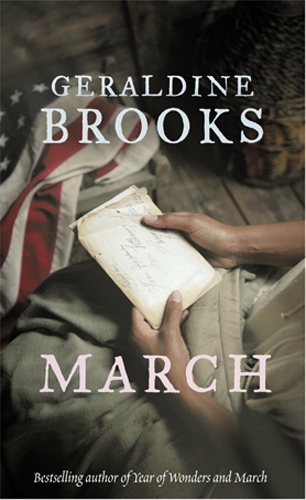
March

A few months ago, I took another dip into the "Civil War" pool with March by Geraldine Brooks, winner of the 2006 Pulitzer Prize. I was intrigued from the start as it is based on the absent father of Alcott's Little Women. What young girls hasn't ripped through the pages of that particulate novel, wondering if Jo will marry Laurie and what will become of the sickly Beth. No little girl wonders what happens to the father. Not even when he returns to the homestead, but, then this novel is about the March women after all.

Geraldine Brooks takes the reader into her idea of Mr. March's life as he leaves his family to experience the war as a chaplain to Union soldiers. When the reader is first introduced to March, he has just escaped death as his unit crosses the Potomac, and he relives the death of a fellow soldier and his own inability to help him. Brooks depicts a man torn between two worlds: one full of violent and hate and the other a beautiful work of fiction he writes to Marmie in his letters home. "I never promised I would write the truth," he admits.

Through the course of the novel, we see March evolve from an idealistic dreamer to a broken man, forced to live with the consequences of his actions, the lives that his weaknesses have cost. He attempts to improve the lives of the "freed" slaves working the plantation for "fair" wages, to save them from a worse fate. But in the end, it is the slaves that save him.

Upon his return home, he is a weak and broken man, unable to live with the guilt. "So this was how it was to be, now: I would do my best to live in the quick world, but the ghosts of the dead would be ever at hand." Returning home to a world that has continued without him, a life seperate from his own. How does he return to that? To find comfort in the arms of his wife and daughters when he has witnessed and caused such devastation and and pain, where the lines of right and wrong are blurred and the rules are unclear.

In the end, however, there is a glimmer of hope as "for an instant, everything was bathed in radiance."

For me, March was similar to Lamb in His Bosom as it made me think of the Civil War in a different way, in a way not taught in the classroom. March comments, "One day I hope to go back. To my wife, to my girls, but also to the man of moral certainty that I was... that innocent man, who knew with such clear confidence exactly what it was that he was meant to do." While this is a nice thought, can we ever go back to the innocence we once had. Like Adam and Eve, once our eyes are opened and we have tasted the sometimes bitter fruit of truth, we can't go back. And like Eve, he becomes aware of the cost associated with ideals and the number of people that are affected by his moral certainty.

I enjoyed the journey with Mr. March. Although at times it was tough to trudge through, I remained a faithful companion to the end of his journey and am better for it.

As Kansas so aptly wrote:
Carry on my wayward son
There'll be peace when you are done
Lay your weary head to rest
Don't you cry no more.

Rest well, Mr. March. Rest well.

Up next, All the Kings Men by Robert Penn Warren, which won the Pulitzer in 1947.
Until then... Happy reading.

Friday, February 4, 2011

... the finest bridge in all of Peru

...broke and precipitated five travellers into the gulf below.

Thus begins the moral journey of The Bridge of San Luis Rey by Thornton Wilder (1928).

First, let me preface by saying that I thoroughly enjoyed this book. As my first introduction to Mr. Thornton Wilder, I was impressed; but then he's no stranger to the Pulitzer, winning two more Pulitzers for Drama (Our Town and The Skin of Our Teeth). Wilder has a way with the written word that is striking and fresh. For example:

Some say that we shall never know and that to the gods we are like the flies that the boys kill on a summer day, and some say, on the contrary, that the very sparrows do not lose a feather that has not been brushed away by the finger of God.

Sadly, my favorite quote in the book as well as the crux of the story is found so early in its reading. The story of The Bridge of San Luis Rey is Brother Juniper's attempt to rationalize or moralize the death of the five unfortunate travellers.

Brother Juniper, a Francisan monk, witnesses the event on his own journey to cross the century old woven bridge. Was this a mere accident, the five traveller simply at the wrong place at the wrong time? Playthings to dispose of at a god's whim? If not, how could God let such a tragedy occur? In an effort to make sense of it, Brother Juniper adopts a scientific approach, interviewing anyone and everyone who knew the victims and gleaning any scrap of knowledge that may or may not be relevant. He then compiles everything into a volume, which is later burned except for one copy that sits neglected in the library at the University of San Marco.

In the remaining three books, we are introduced to the five travellers: Marquesa Montemayor, Pepita, Estaban, Uncle Pio, and Jaime. Amazingly, the lives of all five intertwine in a seemingly random series of events, creating a sense of oneness, a sense of "it could have been me."

In the end, no conclusions are drawn. Rightly so. How ambitious Wilder would be to take on such a conclusion. Yet, we ask are ourselves the very same question today. A hurricane dislodges thousands from their homes and their lives. A terrorist kills thousands of innocence children, mothers and fathers for an idea, a belief. Good things happen to bad people. Bad things happen to good people. How could God let these things happen.

Wilder said that he was posing a question: "Is there a direction and meaning in lives beyond the individual's own will?" According to Wilder, he intentionally left this question unanswered. "We can only pose the question correctly and clearly, and have faith one will ask the question in the right way."

Well said, Mr. Wilder. Well said.

Up next, March by Geraldine Brooks, winner of the 2006 Pulitzer Prize for Fiction.

Until then... Happy reading.

Friday, January 28, 2011

To Die for an Idea...

 It has been over five years since I have read the moving writings of Willa Cather, since I turned in my senior thesis and walked across the graduation stage. What a fickle friend it appears I have turned out to be.

I am glad that I have been able to find her again, and like old friends continuing an interrupted conversation, I have enjoyed her poignant words over morning cups of coffee and felt a homesickness for the smell of cut hay and overturned earth.

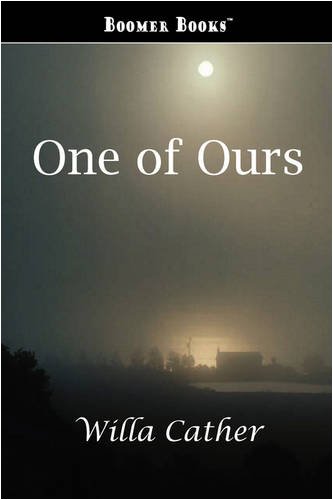
While many books on this literary journey have impacted me, this one has touched me like no other. Winner of the Pulitzer in 1923, One of Ours was Willa Cather's fifth and lesser-known novel about a young man, Claude Wheeler, trying to find meaning in his life.

The son of a wealthy Nebraskan farmer, Claude dreams of life outside of the fenced-in fields he so diligently plows. He catches a small glimpse of other worlds at the community college he attends in the fall and spring. His brief visits with the cultured Erlich family only increases his desire to know  there is more to life than cows and wheat.

His chance to live his life came due to the fact that others were losing theirs. World War I raging overseas, and though America wasn't in the battle yet, young men were enlisting; there's a limit to the dirt that can get under a farm boy's skin. Claude enlists in the army and travels to France, finding his purpose in life through fighting and dying. Perhaps I have said to much. But I do not feel that I have cheapened the experience for you, dear reader. For meaning is in the story, not in the ultimate destination.
     
Cather writes:
            
             "As the troop ship glided down the sea lane, the old man still watched it from the turtle-back. That howling swarm of brown arms and hats and faces looked like nothing by t a crowd of American boys going to a football game somewhere. But the scene was ageless; youths were sailing away to die for an idea, a sentiment, for the mere sound of a phrase... and on their departure they were making vows to a bronze image in the sea."

In a way, it seems foolish. Picking a fight, a war, over ideals, over the mere sound of a phrase. But people have been doing it for centuries, and it will continue long after I am gone. But in a way, if you are not willing to fight for an idea, a belief, then what are you willing to fight for?

"Life was too short that it meant nothing at all unless it were continually reinforced by something that endured; unless the shadows of individual existence came and went against a background that held together."

Thank you, my friend, for this brief but comforting reunion, for taking me "home" to hay, earth, and hard farming people, and for finding meaning in life in the midst of the meaningless. May it not be too long before we meet again.

 Next in the queue is The Bridge of San Luis Rey by Thornton Wilder (1928 winner). I am excited about this one as my father, a man whom I dearly love and respect, loves and respects this book.

Until then.. Happy Reading.

Breathing Lessons

Every once and a while, you stubble across something truly great. Something that resonates within you, and you say, "I get it."

Well, dear readers, I get it. But I get it without knowing how or what, almost as if it surpasses all conscience thought. What I do know is that one this journey of award winning books, I have found few authors from whom I would like to glean more. However, in some ways, I feel that I have found a kindred spirit in Anne Tyler upon reading Breathing Lessons, winner of the 1989 Pulitzer.

Anne Tyler once said "It is very difficult to live among people you love and hold back from offering advice." That pretty much sums up Breathing Lessons, which covers a single day in the life of Maggie Moran.

You first meet Maggie preparing to go with her husband, Ira, to the funeral of her oldest friend's husband. Before they can leave, she has to walk to the shop to pick up the car. In leaving the shop, Maggie hears what seems to be a familiar voice on the radio declaring that she is getting remarried, this time for security. Distracted, Maggie pulls into the road, crashing into a passing vehicle.This single event creates a domino effect, derailing Ira's best laid plans into an uncharted exploration of past grievances and new attempts at redemption.

I immediately feel in love with the character of Maggie Moran. Perhaps it is because she reminds me a little bit of my mama and a little bit of me.  A hopeless Romantic to her very core, Maggie seeks to make everyone happy. Plotting her little disastrous plans, she tries desperately to  reunite her son with his estranged wife and daughter, and her sporadic efforts to rekindle her husband's affections are heartbreakingly humorous.

Anne Tyler is exquisite insight into the vase realm of human emotions and the uncanny ability to accurately depict the depth in the human existence. Her characters are so relatable - so human - because they are flawed people. Flawed, but all the while trying to become better, hoping to become better.

Yes, Ms. Tyler, it is difficult to live with the people you love and hold back from offering advice. I struggle with that daily. Like Maggie, I offer advice with the best of intentions, but the road to Hell is also paved with them, so I am told. I just pray that, in the end, Adah will forgive me.
Up next, One of Ours by Willa Cather, winner of the 1923 Pulitzer.

Until then... Happy reading.

Saturday, December 4, 2010

Ironweed by William Kennedy

"...the only brotherhood they belonged to was the one that asked that enduring question: How do I get through the next twenty minutes? They feared drys, cops, jailers, bosses, moralists, crazies, truth-tellers, and one another. they loved storytellers, liars, whores, fighters, singers, collie dogs that wagged their tails, and generous bandits. Rudy, thought Francis: he's just a bum, but who ain't?"

Believe it or not, this is the flower known as Ironweed. Known more for its incredibly strong stem than it is for its lacy purple petals, you won't find this roadside weed on any dining room tables. However, this is the perfect introduction to the book that bears its name.

William Kennedy published Ironweed in 1983 and won the Pulitzer for it a year later, in 1984. You find it surprising to learn, however, that such a noteworthy work was almost never published. The last in his series of works depicting Depression-era Albany, Ironweed was rejected by eleven major publishing houses before Viking Press agreed to print it, bring unprecedented fame to the streets of Albany, New York.

Whether I am a better person for its publication or not, I can check it off the list. A glowing review, right? In all honesty, I wasn't in the mood for a realist depiction of survival, and perhaps I picked the wrong season to read Ironweed. During this season of Joy and Thanksgiving, reading about a struggling bum on the streets of Depression-era Albany is a far cry from It's a Wonderful Life. There is, however, a glimmer of hope, and I think that is the only thing that kept me plugging along. (At this point, I am sure that I have lost you to a Barnes and Noble search engine, looking to order your own copy.)

The main character is a bum named Frances Phelan, a native of Albany returning after 22 years on the run. As a heavy indicator of what lies ahead, the book starts in the cemetery, in which Frances is trying to earn a few dollars by digging and filling in graves with his friend Rudy. We learn early that Frances is a man not only trying to survive the cold winters of the north but also survive his past.

Responsible for the death of his infant son, a scab trolley driver, and a few others along the way, Frances is haunted by the images and people of his past. Is this the sign of a man unwell? It is really left to the reader to decide, but it is clear that in order for him to stay in Albany, Frances will have to confront and overcome his demons.


The rest I will leave up to you, dear readers. I am ready to put this read behind me and move on to more uplifting thoughts. Up next, Breathing Lessons by Anne Tyler, winner of the Pulitzer in 1989.

Until then... Happy Reading.

Tuesday, September 21, 2010

I am Beloved and she is mine.

Oh, Beloved. Where do I start?


I have tried to read Toni Morrison once before... in high school. I thought at the time that I just wasn't mature enough to read her writings. Now at the budding age of 28, I am still not sure if I am mature enough to read her writings. I have come to the conclusion that Morrison is what I would consider an earthy writer, covering topics I would consider best left behind closed doors.

With that said, though, I really enjoyed this novel.

Beloved, winning the Pulitzer in 1988, is the tragic story of Sethe, a runaway slave. Her life was never easy before or after she obtained her freedom.


When first introduce to the dwelling of 124, you understand that something spiritual dwells there besides Sethe and her surviving daughter, Denver. Sethe's sons have since run away due to the somewhat antagonistic spirit. Within the first couple of chapters, Paul D, a fellow slave from Sweet Home, finds his way to her door, and this is when life really changes for the residents of 124.

Sethe and Paul D bond over a shared past of slavery, torture, and eventual freedom. However, Beloved, the ominous spiritual presents, cannot allow Sethe to move passed her death, to love anyone other than her, or, quite frankly, to be happy. This is when a unknown woman shows up at the home of 124. She calls herself Beloved, but she cannot remember where she came from or where she found her new clothes. All she knows is that, "I am Beloved, and she is mine."

After Beloved's arrival, Paul D is driven out of the house, Sethe secludes herself in her delusional bliss and her true past is revealed. However, much like Ghostbusters, it does have a happy ending. Beloved is sent back from whence she came and if forgotten. There is rumor that she is an escaped slaved whose owner was found murdered awhile back and is a plausible alternative. It is left to the reader to decide.

While it was a good story at the core, I would have felt more comfortable had certain details be left to the imagination. I have a pretty vivid one on my own. Mothers beware if your kids are asked to read this in middle school or high school. If I read another book by Morrison, it will several years from now, when I have read everything on my bucket list.

Up next, Ironweed by William Kennedy, winner of the Pulitzer in 1984.

Until then... Happy reading.

Wednesday, September 1, 2010

The Road...


Once a upon an Armageddon Week on Discovery, I learned something devastating. We consider the human race to be a civilized, mostly caring group of folks. However, when everything is stripped away, you don't have to go very deep to find we are not that much different from the animals. Can this really be true? I don't like to think about such things, but in reading this book one doesn't have much of a choice.

Cormac McCarthy's The Road won the Pulitzer in 2007 and, in true Pulitzer fashion, was made into a major motion picture in 2009. I was hoping that reading this novel would redeem my opinion of McCarthy as a writer. Until now, I have only read two of his works: Child of God and All the Pretty Horses. I remember too much about Child of God (and not in a good way) and I remember very little about All the Pretty Horses. This one, however, I think I will remember for months and years to come. It will haunt me as I lay awake at night, my thoughts unwilling drifting to the post-apocalyptic chaos that possibly awaits us.

The Road is about a man and his son (they could be any man and child for they are not given a name) walking down the road to the coast after a seemingly global apocalypse. Trusting no one in this dog-eat-dog world, father and son sneak through the day, scavenging necessities from wherever they can. Also on the road are bands of carnivores, searching for their next meal.

Pull the civil band-aid off humanity, and you find the basic need to survive. By any means necessary. Even the "good guys" (here the father and son duo) abide by Darwin's survival of the fittest, saving themselves instead of the lives of others. The toughest part of the book for me was a scene about halfway through in which the father and son enter a house looking for supplies and food. They stumble across a trapdoor in the floor and, after breaking the lock and entering, find a huddled mass of people, naked and cold. Waiting to die. Hoping to be rescued. A rescue attempt is impossible when the father sees the bad guys (for lack of better terms) returning to the house. They must choose. I hope I never find myself in a situation of similar terms.

Despite the depressing depiction of humanity, McCarthy does give a few glimmers of hope, glimmers of a world destroyed but not defeated (as Michener would say). One of my favorite moments in the book is when the father puts the boy in the grocery cart they use for storage and runs up and down the hills of road with him. The boy feeling the exhilarating breeze of speed and childhood on his face.

How does this book end you ask? Is there salvation at the coast? Well, my friends. I can't say. McCarthy left the ending so ambiguous, the reader can interpret it how he chooses. Honestly, it comes down to whether you are an optimist or a pessimist. Is there hope? Or are we all doomed in the end?

For me... there is always hope.

Up next, Beloved by Toni Morrison, winning the Pulitzer in 1988.

Actually, if I was honest, I would tell you that I have already finished Beloved and that I am slightly behind on my blogging. And if I was really honest, I would tell you that I am taking a quick detour from the Pulitzer list to read The Last Novel by David Markson. But I will keep that to myself lest you think my resolve is weakening.

Until then... Happy reading.