Tuesday, June 14, 2011

Interpreter of Maladies

So, I must admit... I am a little behind. While I find it somewhat easy to pick up a book for a few minutes every other day or so, I find it increasing difficult to write about what I read. I finished Interpreter of Maladies a month or so ago, and I am just now sitting down to the computer to write my thoughts. If I were to be completely honest, I would tell you that I have already finished The Brief Wondrous Life of Oscar Wao as well. I haven't written about it either. And while I am not diligent, I find it necessary to record my journey through some of the greatest novels America has to offer. And so I continue....

Interpreter of Maladies by Jhumpa Lahiri is a wonderful short collection of stories. All of which relate to the author's native country of India. Some take place in India; others depict Indians adjusting to the American way.  Lahiri has a wonderful way of weaving such a fine seam between the two countries, I found it difficult, at times, to know on what side of the Atlantic to picture myself.

Within each story, I felt dropped deliberately into the middle of a person's life to decipher the who, what, when, where, and how of the matter, like when you tune into a 10-year-running soap opera for the first time. Lahiri has a quality reminiscent of J.D. Salinger in Nine Stories (this collect also has nine stories, but I am sure that is just coincidence), and she is able to capture emotion in the simple moments, leaving the reader uncertain of themselves.

My two favorite stories with this collection are "A Temporary Matter" and "Interpreter of Maladies." In "A Temporary Matter," a couple has received a letter that their electricity will be temporary shut off at 8:00 every night. Under the protective covering of darkness and candlelight, the wife uses this as a way for the two to reveals things about themselves that the other doesn't know. As the story continues, a temporary matter takes on a new meaning, and the end leaves you dangling in the uncertainty of the couple's future.

In "Interpreter of Maladies," the main character is Mr. Kapasi, an interpreter for a doctor during the week and a chauffeur on the weekend. This particular weekend, he is chauffeuring an Americanized Indian family who is visiting their native country after a considerable absence. They are more tourists that family returning for a visit. Mr. Kapasi is flattered when the wife begins to take an interest in him and his position as an interpreter of maladies. To his own wife, he is merely a doctor's assistant, a failure, but to his passenger, his position was "romantic" and carried great responsibility.  He finds himself growing infatuated with this glamorous woman, too busy for her children and not really paying much attention to anyone other than herself. He is quickly reminded, however, that brief moments can't last a lifetime.

It's king of funny to think, though, that that is what a lifetime is: a series of brief moments and small beauties. And it is ofter the little things that we remember about a person: Nanny cutting fabric holding pens between her teeth, coloring my dad's toenails with a #2 pencil, brushing off my daughter's knees after a fall. Small brief moments that make up a lifetime. I want to collect them all.

Up next, my report on The Brief Wondrous Life of Oscar Wao.

Until then... Happy reading.

Monday, June 13, 2011

All the King's Men

So after a few long months, I have finally finished Robert Penn Warren's All the King's Men, winner of the 1947 Pulitzer Prize. I wasn't excited about reading this one. If I were honest, I would say that I was dreading it... about as much as I am dreading Gone with the Wind. Reading the back cover (and I know you shouldn't judge a book by its proverbial cover), I was anticipating a book about Louisiana politics. If there is one thing I hate more than a boring book, it's a book about politics. But in an effort to keep an open mind, I greeting the ambitious task with a large cup of coffee and nothing by time.

Sure. Time. Something I have loads of as a full-time employee, wife, and mother. But I digress.

I will be the first to say that I enjoyed the journey, the ambling pathways and detours it took, in a winded but even pace. And while it was largely about corrupt politics (as if there is any other kind), it was more about the journey of the narrator, Jack Burden.

Appropriately named, Jack Burden is a man carrying the burden of a successful family and his inability to rise to the challenge in his own right. He quites his job at the paper when he refuses to publish an article in favor of a candidate whom he can't support. He seemingly finds his salvation in Willie Stark, a good ol' boy from the country with no experience in politics but a good heart to help the common man. My how power can change a man!

You know from the end of the first chapter (might I mention that they are about 50 pages long!), you know that things are not going to end too well for Willie Stark and his pawns. It just takes another 550 pages for you to find out why. Through those pages, you wander in and out of the past, learning how Willie Stark became the Boss, why Burden is the way he is, and how everything fell apart upon uncovering a pretty hefty secret.

While the book centers around Louisiana politics, the heart of the novel rests in human nature and moral courage. Is it human nature to lie, cheat, and steal to get what you want? Perhaps. When left to our own devices, are we just like animals: survival of the fittest? Perhaps.

My daddy has always said that the measure of the good in a person is also the measure of the bad. I think my dad is a pretty smart man. The most beautiful places on earth are also the deadliest, full of venomous animals, and carnivorous creatures. While man strives to be good and do good things, the means do not always justify the end. While Burden tries to be a good man, he misses his opportunity to rise up and do what is morally right, and while Willie Stark wants to do right by the common man, his means are neither moral or ethical. Perhaps he has just learned to play the game.

Something, I think, I will never learn to do.

So I leave the realm of politics for the Taj Mahal. Up next, Interpreter of Maladies by Jhumpta Lahiri, winner of the 2000 Pulitzer Prize.

Until then... Happy reading.


Thursday, May 5, 2011

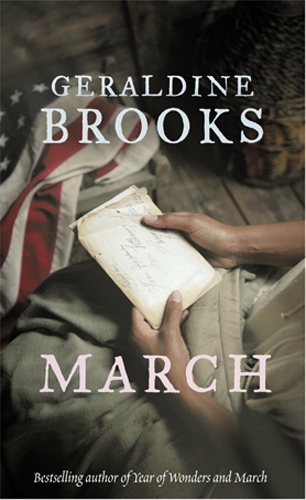
March

A few months ago, I took another dip into the "Civil War" pool with March by Geraldine Brooks, winner of the 2006 Pulitzer Prize. I was intrigued from the start as it is based on the absent father of Alcott's Little Women. What young girls hasn't ripped through the pages of that particulate novel, wondering if Jo will marry Laurie and what will become of the sickly Beth. No little girl wonders what happens to the father. Not even when he returns to the homestead, but, then this novel is about the March women after all.

Geraldine Brooks takes the reader into her idea of Mr. March's life as he leaves his family to experience the war as a chaplain to Union soldiers. When the reader is first introduced to March, he has just escaped death as his unit crosses the Potomac, and he relives the death of a fellow soldier and his own inability to help him. Brooks depicts a man torn between two worlds: one full of violent and hate and the other a beautiful work of fiction he writes to Marmie in his letters home. "I never promised I would write the truth," he admits.

Through the course of the novel, we see March evolve from an idealistic dreamer to a broken man, forced to live with the consequences of his actions, the lives that his weaknesses have cost. He attempts to improve the lives of the "freed" slaves working the plantation for "fair" wages, to save them from a worse fate. But in the end, it is the slaves that save him.

Upon his return home, he is a weak and broken man, unable to live with the guilt. "So this was how it was to be, now: I would do my best to live in the quick world, but the ghosts of the dead would be ever at hand." Returning home to a world that has continued without him, a life seperate from his own. How does he return to that? To find comfort in the arms of his wife and daughters when he has witnessed and caused such devastation and and pain, where the lines of right and wrong are blurred and the rules are unclear.

In the end, however, there is a glimmer of hope as "for an instant, everything was bathed in radiance."

For me, March was similar to Lamb in His Bosom as it made me think of the Civil War in a different way, in a way not taught in the classroom. March comments, "One day I hope to go back. To my wife, to my girls, but also to the man of moral certainty that I was... that innocent man, who knew with such clear confidence exactly what it was that he was meant to do." While this is a nice thought, can we ever go back to the innocence we once had. Like Adam and Eve, once our eyes are opened and we have tasted the sometimes bitter fruit of truth, we can't go back. And like Eve, he becomes aware of the cost associated with ideals and the number of people that are affected by his moral certainty.

I enjoyed the journey with Mr. March. Although at times it was tough to trudge through, I remained a faithful companion to the end of his journey and am better for it.

As Kansas so aptly wrote:
Carry on my wayward son
There'll be peace when you are done
Lay your weary head to rest
Don't you cry no more.

Rest well, Mr. March. Rest well.

Up next, All the Kings Men by Robert Penn Warren, which won the Pulitzer in 1947.
Until then... Happy reading.

Friday, February 4, 2011

... the finest bridge in all of Peru

...broke and precipitated five travellers into the gulf below.

Thus begins the moral journey of The Bridge of San Luis Rey by Thornton Wilder (1928).

First, let me preface by saying that I thoroughly enjoyed this book. As my first introduction to Mr. Thornton Wilder, I was impressed; but then he's no stranger to the Pulitzer, winning two more Pulitzers for Drama (Our Town and The Skin of Our Teeth). Wilder has a way with the written word that is striking and fresh. For example:

Some say that we shall never know and that to the gods we are like the flies that the boys kill on a summer day, and some say, on the contrary, that the very sparrows do not lose a feather that has not been brushed away by the finger of God.

Sadly, my favorite quote in the book as well as the crux of the story is found so early in its reading. The story of The Bridge of San Luis Rey is Brother Juniper's attempt to rationalize or moralize the death of the five unfortunate travellers.

Brother Juniper, a Francisan monk, witnesses the event on his own journey to cross the century old woven bridge. Was this a mere accident, the five traveller simply at the wrong place at the wrong time? Playthings to dispose of at a god's whim? If not, how could God let such a tragedy occur? In an effort to make sense of it, Brother Juniper adopts a scientific approach, interviewing anyone and everyone who knew the victims and gleaning any scrap of knowledge that may or may not be relevant. He then compiles everything into a volume, which is later burned except for one copy that sits neglected in the library at the University of San Marco.

In the remaining three books, we are introduced to the five travellers: Marquesa Montemayor, Pepita, Estaban, Uncle Pio, and Jaime. Amazingly, the lives of all five intertwine in a seemingly random series of events, creating a sense of oneness, a sense of "it could have been me."

In the end, no conclusions are drawn. Rightly so. How ambitious Wilder would be to take on such a conclusion. Yet, we ask are ourselves the very same question today. A hurricane dislodges thousands from their homes and their lives. A terrorist kills thousands of innocence children, mothers and fathers for an idea, a belief. Good things happen to bad people. Bad things happen to good people. How could God let these things happen.

Wilder said that he was posing a question: "Is there a direction and meaning in lives beyond the individual's own will?" According to Wilder, he intentionally left this question unanswered. "We can only pose the question correctly and clearly, and have faith one will ask the question in the right way."

Well said, Mr. Wilder. Well said.

Up next, March by Geraldine Brooks, winner of the 2006 Pulitzer Prize for Fiction.

Until then... Happy reading.

Friday, January 28, 2011

To Die for an Idea...

 It has been over five years since I have read the moving writings of Willa Cather, since I turned in my senior thesis and walked across the graduation stage. What a fickle friend it appears I have turned out to be.

I am glad that I have been able to find her again, and like old friends continuing an interrupted conversation, I have enjoyed her poignant words over morning cups of coffee and felt a homesickness for the smell of cut hay and overturned earth.

While many books on this literary journey have impacted me, this one has touched me like no other. Winner of the Pulitzer in 1923, One of Ours was Willa Cather's fifth and lesser-known novel about a young man, Claude Wheeler, trying to find meaning in his life.

The son of a wealthy Nebraskan farmer, Claude dreams of life outside of the fenced-in fields he so diligently plows. He catches a small glimpse of other worlds at the community college he attends in the fall and spring. His brief visits with the cultured Erlich family only increases his desire to know  there is more to life than cows and wheat.

His chance to live his life came due to the fact that others were losing theirs. World War I raging overseas, and though America wasn't in the battle yet, young men were enlisting; there's a limit to the dirt that can get under a farm boy's skin. Claude enlists in the army and travels to France, finding his purpose in life through fighting and dying. Perhaps I have said to much. But I do not feel that I have cheapened the experience for you, dear reader. For meaning is in the story, not in the ultimate destination.
     
Cather writes:
            
             "As the troop ship glided down the sea lane, the old man still watched it from the turtle-back. That howling swarm of brown arms and hats and faces looked like nothing by t a crowd of American boys going to a football game somewhere. But the scene was ageless; youths were sailing away to die for an idea, a sentiment, for the mere sound of a phrase... and on their departure they were making vows to a bronze image in the sea."

In a way, it seems foolish. Picking a fight, a war, over ideals, over the mere sound of a phrase. But people have been doing it for centuries, and it will continue long after I am gone. But in a way, if you are not willing to fight for an idea, a belief, then what are you willing to fight for?

"Life was too short that it meant nothing at all unless it were continually reinforced by something that endured; unless the shadows of individual existence came and went against a background that held together."

Thank you, my friend, for this brief but comforting reunion, for taking me "home" to hay, earth, and hard farming people, and for finding meaning in life in the midst of the meaningless. May it not be too long before we meet again.

 Next in the queue is The Bridge of San Luis Rey by Thornton Wilder (1928 winner). I am excited about this one as my father, a man whom I dearly love and respect, loves and respects this book.

Until then.. Happy Reading.

Breathing Lessons

Every once and a while, you stubble across something truly great. Something that resonates within you, and you say, "I get it."

Well, dear readers, I get it. But I get it without knowing how or what, almost as if it surpasses all conscience thought. What I do know is that one this journey of award winning books, I have found few authors from whom I would like to glean more. However, in some ways, I feel that I have found a kindred spirit in Anne Tyler upon reading Breathing Lessons, winner of the 1989 Pulitzer.

Anne Tyler once said "It is very difficult to live among people you love and hold back from offering advice." That pretty much sums up Breathing Lessons, which covers a single day in the life of Maggie Moran.

You first meet Maggie preparing to go with her husband, Ira, to the funeral of her oldest friend's husband. Before they can leave, she has to walk to the shop to pick up the car. In leaving the shop, Maggie hears what seems to be a familiar voice on the radio declaring that she is getting remarried, this time for security. Distracted, Maggie pulls into the road, crashing into a passing vehicle.This single event creates a domino effect, derailing Ira's best laid plans into an uncharted exploration of past grievances and new attempts at redemption.

I immediately feel in love with the character of Maggie Moran. Perhaps it is because she reminds me a little bit of my mama and a little bit of me.  A hopeless Romantic to her very core, Maggie seeks to make everyone happy. Plotting her little disastrous plans, she tries desperately to  reunite her son with his estranged wife and daughter, and her sporadic efforts to rekindle her husband's affections are heartbreakingly humorous.

Anne Tyler is exquisite insight into the vase realm of human emotions and the uncanny ability to accurately depict the depth in the human existence. Her characters are so relatable - so human - because they are flawed people. Flawed, but all the while trying to become better, hoping to become better.

Yes, Ms. Tyler, it is difficult to live with the people you love and hold back from offering advice. I struggle with that daily. Like Maggie, I offer advice with the best of intentions, but the road to Hell is also paved with them, so I am told. I just pray that, in the end, Adah will forgive me.
Up next, One of Ours by Willa Cather, winner of the 1923 Pulitzer.

Until then... Happy reading.

Saturday, December 4, 2010

Ironweed by William Kennedy

"...the only brotherhood they belonged to was the one that asked that enduring question: How do I get through the next twenty minutes? They feared drys, cops, jailers, bosses, moralists, crazies, truth-tellers, and one another. they loved storytellers, liars, whores, fighters, singers, collie dogs that wagged their tails, and generous bandits. Rudy, thought Francis: he's just a bum, but who ain't?"

Believe it or not, this is the flower known as Ironweed. Known more for its incredibly strong stem than it is for its lacy purple petals, you won't find this roadside weed on any dining room tables. However, this is the perfect introduction to the book that bears its name.

William Kennedy published Ironweed in 1983 and won the Pulitzer for it a year later, in 1984. You find it surprising to learn, however, that such a noteworthy work was almost never published. The last in his series of works depicting Depression-era Albany, Ironweed was rejected by eleven major publishing houses before Viking Press agreed to print it, bring unprecedented fame to the streets of Albany, New York.

Whether I am a better person for its publication or not, I can check it off the list. A glowing review, right? In all honesty, I wasn't in the mood for a realist depiction of survival, and perhaps I picked the wrong season to read Ironweed. During this season of Joy and Thanksgiving, reading about a struggling bum on the streets of Depression-era Albany is a far cry from It's a Wonderful Life. There is, however, a glimmer of hope, and I think that is the only thing that kept me plugging along. (At this point, I am sure that I have lost you to a Barnes and Noble search engine, looking to order your own copy.)

The main character is a bum named Frances Phelan, a native of Albany returning after 22 years on the run. As a heavy indicator of what lies ahead, the book starts in the cemetery, in which Frances is trying to earn a few dollars by digging and filling in graves with his friend Rudy. We learn early that Frances is a man not only trying to survive the cold winters of the north but also survive his past.

Responsible for the death of his infant son, a scab trolley driver, and a few others along the way, Frances is haunted by the images and people of his past. Is this the sign of a man unwell? It is really left to the reader to decide, but it is clear that in order for him to stay in Albany, Frances will have to confront and overcome his demons.


The rest I will leave up to you, dear readers. I am ready to put this read behind me and move on to more uplifting thoughts. Up next, Breathing Lessons by Anne Tyler, winner of the Pulitzer in 1989.

Until then... Happy Reading.